Organization
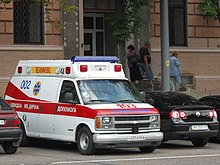
Depending on country, area within country, or clinical need, emergency medical services may be provided by one or more different types of organization. This variation may lead to large differences in levels of care and expected scope of practice. Some countries closely regulate the industry (and may require anyone working on an ambulance to be qualified to a set level), whereas others allow quite wide differences between types of operator.
Government ambulance serviceedit
Operating separately from (although alongside) the fire and police services of the area, these ambulances are funded by local, provincial or national governments. In some countries, these only tend to be found in big cities, whereas in countries such as the United Kingdom, almost all emergency ambulances are part of a national health system.
In the United States, ambulance services provided by a local government are often referred to as "third service" EMS (the fire department, police department, and separate EMS forming an emergency services trio) by the employees of said service, as well as other city officials and residents. Government ambulance services also have to take civil service exams just like government fire departments and police. In the United States, certain federal government agencies employ emergency medical technicians at the basic and advanced life support levels, such as the National Park Service and the Federal Bureau of Prisons.
Fire- or police-linked serviceedit
In countries such as the United States, Japan, France, and parts of India; ambulances can be operated by the local fire or police services. Fire-based EMS is the most common model in the United States, where nearly all urban fire departments provide EMS and a majority of emergency transport ambulance services in large cities are part of fire departments. It is somewhat rare for a police department in the United States to provide EMS or ambulance services, although many police officers have basic medical training.
Charity ambulance serviceedit
Charities or non-profit companies operate some emergency medical services. They are primarily staffed by volunteers, though some have paid employees. These may be linked to a volunteer fire service, and some volunteers may provide both services. Some ambulance charities specialize in providing cover at public gatherings and events (e.g. sporting events), while others provide care to the wider community.
The International Red Cross and Red Crescent Movement is the largest charity in the world that provides emergency medicine. (in some countries, it operates as a private ambulance service). Other organisations include St John Ambulance, the Order of Malta Ambulance Corps and Hatzalah, as well as small local volunteer agencies. In the United States, volunteer ambulances are rarer, but can still be seen in both metropolitan and rural areas (e.g. Hatzalah). Charities such as BASICS Scotland, specialise in facilitating training medical professionals to volunteer to assist the statutory ambulance services in the care of patients, through their attendance at those with serious illnesses or injuries.
A few charities provide ambulances for taking patients on trips or vacations away from hospitals, hospices or care homes where they are in long-term care. Examples include the UK's Jumbulance project.
Private ambulance serviceedit
Some ambulances are operated by commercial companies with paid employees, usually on a contract to the local or national government, Hospital Networks, Health Care Facilities and Insurance Companies.
In the USA private ambulance companies provide 911 emergency services in large cities as well as most rural areas by contracting with local governments. In areas that the local County or City provide their own 911 service, private companies provide discharges and transfers from hospitals and to/from other health related facilities and homes. In most areas private companies are part of the local government Emergency Disaster plan, and are relied upon heavily for the overall EMS response, treatment and recovery.
In some areas, private companies may provide only the patient transport elements of ambulance care (i.e. non-urgent), but in some places, they are contracted to provide emergency care, or to form a 'second tier' response, where they only respond to emergencies when all of the full-time emergency ambulance crews are busy. This may mean that a government or other service provide the 'emergency' cover, whilst a private firm may be charged with 'minor injuries' such as cuts, bruises or even helping the mobility-impaired if they have for example fallen and simply need help to get up again, but do not need treatment. This system has the benefit of keeping emergency crews available at all times for genuine emergencies. These organisations may also provide services known as 'Stand-by' cover at industrial sites or at special events. In Latin America, private ambulance companies are often the only readily available EMS service
Combined emergency serviceedit
These are full service emergency service agencies, which may be found in places such as airports or large colleges and universities. Their key feature is that all personnel are trained not only in ambulance (EMT) care, but as a firefighter and a peace officer (police function). They may be found in smaller towns and cities, where demand or budget is too low to support separate services. This multi-functionality allows to make the most of limited resource or budget, but having a single team respond to any emergency.
Hospital-based serviceedit
Hospitals may provide their own ambulance service as a service to the community, or where ambulance care is unreliable or chargeable. Their use would be dependent on using the services of the providing hospital.
Internal ambulancesedit
Many large factories and other industrial centres, such as chemical plants, oil refineries, breweries and distilleries have ambulance services provided by employers as a means of protecting their interests and the welfare of their staff. These are often used as first response vehicles in the event of a fire or explosion.


Comments
Post a Comment